New national guidelines for PSA testing and the early detection of prostate cancer
Australia has new national guidelines for the early detection of prostate cancer. They set out when a PSA test should be offered, how often, and what should happen next if your result is higher than expected for your age.
You can download the full guidelines and a free one-page summary below.
For more information and to talk to a PCFA Specialist Nurse, call us on 1800 22 00 99 or email telenurse@pcfa.org.au.
PSA testing: when should you start?
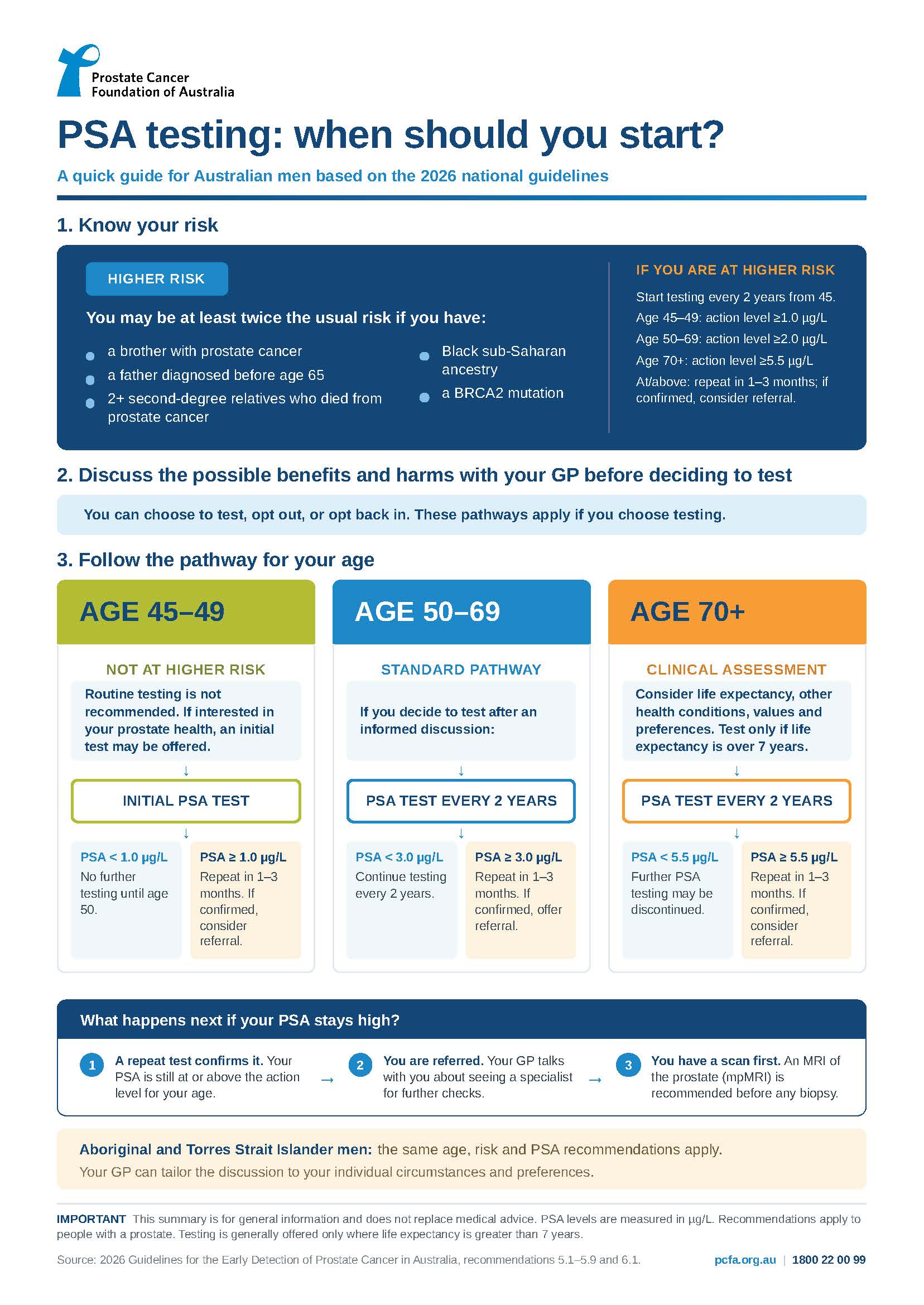
When you start PSA testing depends on your age and your individual risk factors, such as family history.
The document linked below gives you a plain-language summary on a single A4 page. It shows the testing pathway for each age group, what the PSA action levels mean, and what happens if your result comes back high.
Print it, pin it up, or take it to your next GP appointment.
To learn more about free PSA testing in Australia, click here.
2026 Guidelines for the Early Detection of Prostate Cancer in Australia
The complete evidence-based recommendations, written for health professionals. Covers risk assessment, PSA testing intervals, action levels, referral and investigation.
Information materials for the community
These materials help to answer frequently asked questions and explain the PSA testing pathway.
- Frequently asked questions
- The PSA testing pathway
- Mobile PSA testing
- Support Groups and PSA testing
- PCFA Specialist Nursing & Support Services
- Free PSA testing in Australia
What the guidelines recommend
The Guidelines include updated recommendations across every stage of early detection, including risk assessment, PSA testing, use of multiparametric MRI before biopsy, active surveillance, and care for priority populations.
If you do choose to test, here is what the guidelines recommend.
If you are 45 to 49
Routine testing is not recommended at this age unless you are at higher risk. If you are interested in your prostate health, your GP may offer you an initial test.
- If your PSA is under 1.0 µg/L, no further testing is needed until you are 50.
- If it is 1.0 µg/L or above, the test should be repeated in one to three months. If the result is confirmed, your GP will consider referring you to a specialist.
If you are 50 to 69
After an informed discussion with your GP, testing every two years is recommended.
- If your PSA is under 3.0 µg/L, keep testing every two years.
- If it is 3.0 µg/L or above, the test should be repeated within one to three months. If the result is confirmed, you should be offered a referral.
If you are 70 or older
Testing is based on clinical assessment. Your GP will consider your life expectancy, other health conditions, and what matters to you. Testing is generally offered where life expectancy is greater than seven years.
- If your PSA is under 5.5 µg/L, further testing may be stopped.
- If it is 5.5 µg/L or above, the test should be repeated in one to three months. If the result is confirmed, your GP will consider referring you to a specialist.
If you are at higher risk
You may be at least twice the usual risk of prostate cancer if you have:
- a brother with prostate cancer
- a father diagnosed before age 65
- two or more second-degree relatives who died from prostate cancer
- Black sub-Saharan ancestry
- a BRCA2 mutation
If any of these apply to you, the guidelines recommend testing every two years from age 45, with lower action levels:
- Age 45 to 49: 1.0 µg/L or above
- Age 50 to 69: 2.0 µg/L or above
- Age 70 and over: 5.5 µg/L or above
At or above these levels, the test should be repeated in one to three months. If the result is confirmed, your GP will consider referring you to a specialist.
What happens if your PSA stays high
A single high reading does not mean you have prostate cancer. PSA can rise for several reasons.
- A repeat test confirms it. Your PSA is still at or above the action level for your age.
- You are referred. Your GP talks with you about seeing a specialist for further checks.
- You have a scan first. An MRI of the prostate (mpMRI) is recommended before any biopsy.
Aboriginal and Torres Strait Islander men
The same age, risk and PSA recommendations apply. Your GP can tailor the discussion to your individual circumstances and preferences.
For health professionals
The guidelines provide evidence-based recommendations on risk assessment, PSA testing intervals, age-specific action levels, referral thresholds and the use of mpMRI before biopsy.
All information materials for the community provided above can be printed on demand for clinics and waiting rooms.
Talk to someone
You do not have to work through this on your own. Our Prostate Cancer Specialist Nurses can talk you through what the guidelines mean for you, help you prepare for a conversation with your GP, and answer questions about your results.
Call 1800 22 00 99 or email telenurse@pcfa.org.au.
Important
This page is a general summary and does not replace medical advice. PSA levels are measured in µg/L. These recommendations apply to people with a prostate. Testing is generally offered only where life expectancy is greater than seven years.
The guidelines replace the 2016 PSA testing guidelines and were approved by the National Health and Medical Research Council on 18 May 2026.
Source: 2026 Guidelines for the Early Detection of Prostate Cancer in Australia, recommendations 5.1–5.9 and 6.1. Approved by the National Health and Medical Research Council, 18 May 2026.